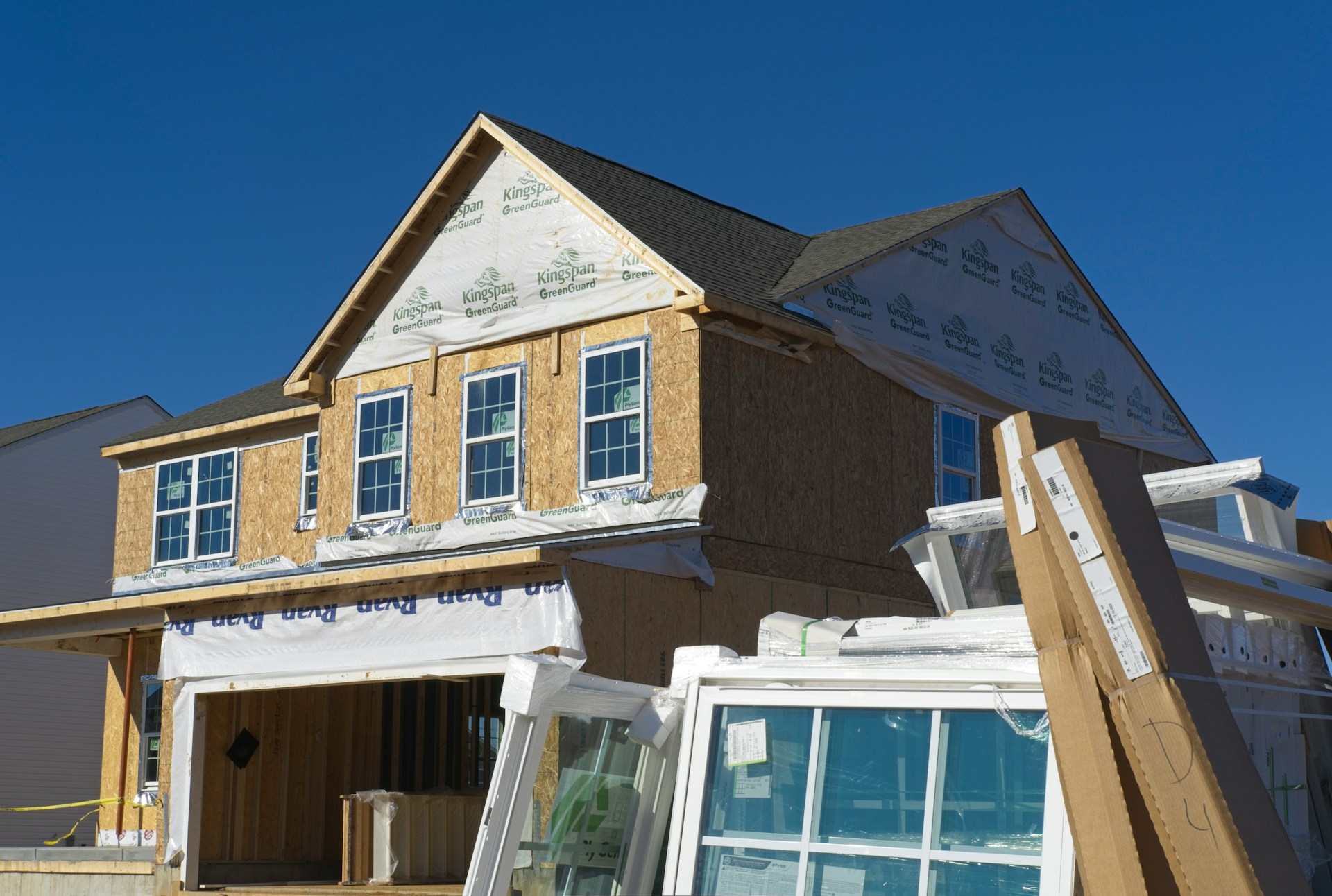
What's a construction loan?
A construction loan is a short-term, specialized financing product designed to fund the building of a new home from the ground up, covering the costs of land acquisition (in some cases), labor, materials, permits, and other expenses associated with the construction process.
Unlike other mortgage types — which provides a lump sum disbursement to purchase an already-existing property — a construction loan releases funds incrementally in a series of scheduled payments known as draws, which are tied to specific milestones in the construction timeline such as foundation completion, framing, rough-in of mechanical systems, and final completion.
This draw structure ensures that funds are released only as work is actually completed and verified, protecting both the lender and the borrower from funds being misused or construction stalling due to financial mismanagement.
Construction loans are inherently more complex, more risky from a lender's perspective, and more demanding in terms of documentation and oversight than standard mortgage products, which is why fewer lenders offer them and the qualification requirements tend to be more stringent.
How Construction Loans Work
During the construction phase, the borrower typically pays interest only on the funds that have been drawn to date — not on the full loan amount — which helps manage cash flow during a period when the borrower may also be paying rent or an existing mortgage elsewhere.
As each draw is requested, the lender will usually send an inspector to the property to verify that the work corresponding to that draw has been satisfactorily completed before releasing the next tranche of funds.
The interest rate on a construction loan is almost always variable, tied to the prime rate or another benchmark, and tends to be higher than conventional mortgage rates — typically ranging from 1% to 2% above standard mortgage rates — reflecting the elevated risk the lender assumes during construction.
The loan term is short, usually 12 to 18 months, which is intended to cover the construction period, after which the loan must either be paid off or converted into permanent long-term financing.
Types of Construction Loans
There are several structures for construction financing, each suited to different situations and borrower needs:
• Construction-to-Permanent Loan (One-Time Close): This is the most popular and convenient option for most borrowers building a primary residence. With a one-time close loan, the buyer secures a single loan that covers both the construction phase and the permanent mortgage, going through only one application process, one set of closing costs, and one closing. Once construction is complete, the loan automatically converts — or "rolls over" — into a traditional long-term mortgage without requiring the borrower to requalify or go through another closing. This structure provides significant cost savings and reduces the risk of being unable to secure permanent financing after construction is complete.
• Construction-Only Loan (Two-Time Close): In this structure, the construction loan and the permanent mortgage are two entirely separate transactions. The borrower takes out a short-term construction loan to fund the build, then upon completion applies for and closes on a separate traditional mortgage to pay off the construction loan. While this approach offers more flexibility — the borrower can shop for the best mortgage rates at the time of completion — it also means two separate closings, two sets of closing costs, and the risk that the borrower's financial situation or the lending environment may have changed unfavorably by the time they seek permanent financing.
• Renovation Construction Loan: Sometimes called a 203(k) loan in its FHA form or a HomeStyle loan in its conventional Fannie Mae form, this product is designed for buyers who are purchasing an existing home that requires significant renovation or rehabilitation rather than building from scratch. The loan bundles the purchase price and estimated renovation costs into a single mortgage, with renovation funds held in escrow and disbursed to contractors as work is completed.
• Owner-Builder Construction Loan: This specialized and relatively rare product is designed for borrowers who intend to act as their own general contractor and manage the construction process themselves rather than hiring a professional builder. Lenders are extremely cautious with these loans due to the significantly higher risk of cost overruns, delays, and quality issues when a non-professional is managing the build, and qualification requirements are typically very strict — often requiring the borrower to demonstrate documented construction experience.
Qualification Requirements
Because of the complexity and risk involved, lenders impose more rigorous qualification standards for construction loans than for traditional mortgages. Borrowers can generally expect the following requirements:
• A higher credit score — most lenders require a minimum of 680 to 720, with the best terms reserved for scores of 740 and above
• A larger down payment — typically 20% to 25% of the total project cost, which includes both land and construction expenses
• Detailed construction plans and specifications — including architectural drawings, a comprehensive budget, a construction timeline, and a signed contract with a licensed general contractor
• Builder approval — the lender will vet and approve the general contractor, reviewing their license, insurance, experience, and financial stability before agreeing to fund the project
• Appraisal based on plans — since the home does not yet exist, the lender orders an appraisal based on the proposed plans and comparable completed homes in the area to establish the projected "as-completed" value of the property
• Proof of land ownership or simultaneous land acquisition — if the borrower does not already own the lot, the land purchase is typically folded into the construction loan
Key Risks and Considerations
Building a home is an inherently unpredictable process, and construction loans come with unique risks that buyers should carefully consider.
Cost overruns are extremely common — materials prices fluctuate, unexpected site conditions arise, and change orders accumulate — and if the project exceeds the loan amount the borrower must cover the difference out of pocket.
Construction delays caused by weather, labor shortages, permit issues, or supply chain disruptions can push the project beyond the loan term, potentially requiring an extension that comes with additional fees.
Borrowers should also maintain a contingency reserve of at least 10% to 15% of the total construction budget to absorb unexpected costs without jeopardizing the project. Additionally, during the construction period the borrower is carrying the financial burden of the construction loan interest payments while potentially also paying for housing elsewhere, which can strain cash flow considerably.
Despite these complexities, for buyers who want a newly built home tailored precisely to their specifications, a construction loan is an essential and powerful financial tool that — when properly planned and managed — can make the dream of a custom-built home a reality.